
THE GOAD'S GUIDE: FIRE INSURANCE PLANS IN CANADA
PLAN CONTENT

The large-scale block maps of Canadian communities created by Charles Goad and his successors (and competitors) over the course of a century depicted very specific building details such as their shape, height, and construction materials. Today, this wealth of information provides a virtual time machine for urban researchers who know how to properly interpret it.
Format

A ruler placed on a plan shows the relative size of the pages measuring over 3.5 square feet.
The fire insurance plans originally published by Charles Goad were a massive 21” by 25” in size. Plans for smaller towns were issued as loose sheets, while those for larger cities had the option of their sheets being glued back to back and bound in hardcovers with leather index tabs affixed to them. Often filled with dozens of pages and bookended with heavy covers, these bound city volumes offered a healthy workout for the agents that referenced them daily.
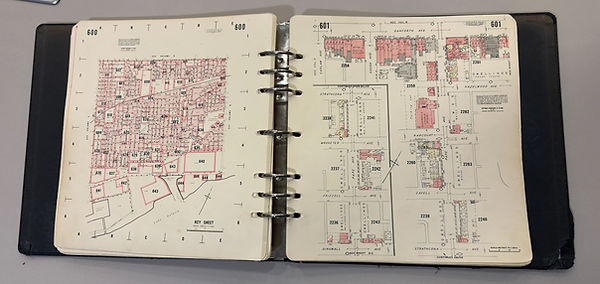
The Underwriter’s Survey Bureau retained this oversize format when they bought out the Goad Company in 1917 and continued its use until 1952. Beginning that year, new editions of plans were published in a much smaller 12” x 13” format with punched holes so the sheets could be inserted into a 7-ring binder.
Introductory Pages
All fire insurance plans included key plans and symbol keys and most included indexes. Plans for smaller communities would often combine these introductory features onto a single page while plans for large urban centres would require separate pages.
Key Plans
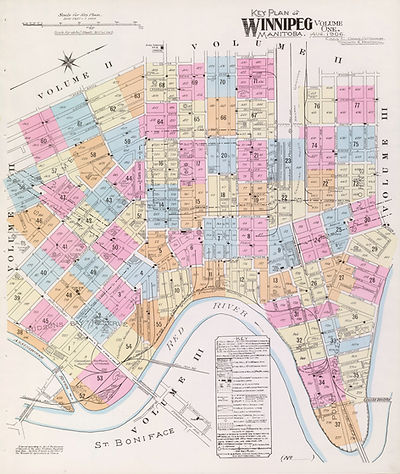
Key plans (or “key sheets” after 1952) were small-scale maps of the entire survey area depicting the boundaries of the individual block plans and their corresponding sheet numbers.
For larger communities, the less developed parts of the city would have sheet numbers reserved for them until they were populated enough to warrant the expense of a survey.
With the introduction of the revamped format in 1952, areas that had not undergone significant change since the previous edition were excluded from the plan. The depiction of these excluded areas in the key plan changed over the years: prior to 1952 they were identified by coloured outlines, from 1952 to 1962 with yellow shading and, from 1963 onward, with red shading.
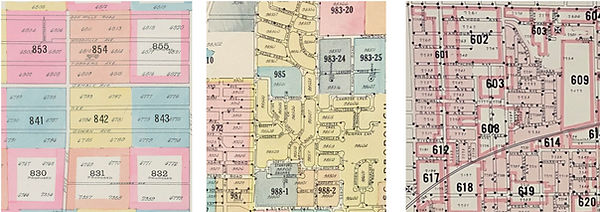
Formatting for unsurveyed areas prior to 1952 (left), 1952-1962 (middle), and after 1962 (right).
Indexes
Indexes could be one of three types:
-
street indexes that catalogued the streets covered in the plan, along with their original names where applicable
-
block indexes that listed arbitrary numbers assigned to individual blocks for continuity when referencing sequential editions of a plan
-
specials indexes that itemized high-risk businesses and places of public assembly
Plans consisting of just one or two sheets would typically omit these indexes due to the small amount of area being covered.
All types of indexes were retired upon the switch to the ring binder format in 1952.


left: combined key plan & index page for mid-size plan, right: dedicated index page for large city
Symbol Keys
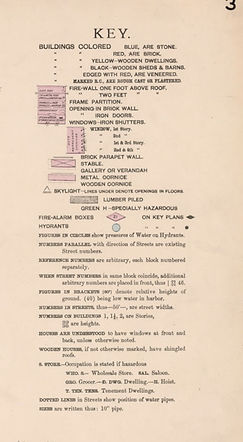
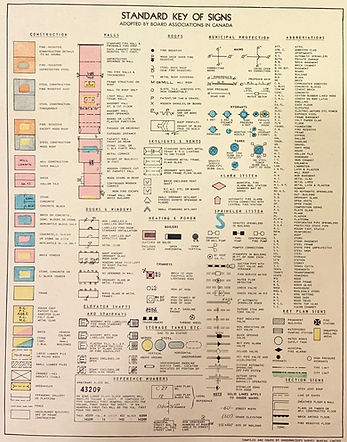
Sample symbol keys from the Goad era (1880) versus the USB / CUA era (1956).
Interpretive legends - called “keys” up until the 1950s - explained the meaning of colors, symbols, and abbreviations that denoted street widths, fire-protection facilities, and the materials, shape, height, placement, and use of buildings, among many other details. Their scope varied significantly between the Goad years when they were relatively minimal and the USB era when they became much more comprehensive. Toronto Archives’ former chief archivist Wayne Reeves has created a compendium of symbol keys used over the years that is particularly helpful when viewing online plans that omit their introductory pages.
What’s not included in the earlier keys is an index of abbreviations that Goad would use to label buildings’ specific uses or construction details. Fortunately, he left behind the following list in his company records:
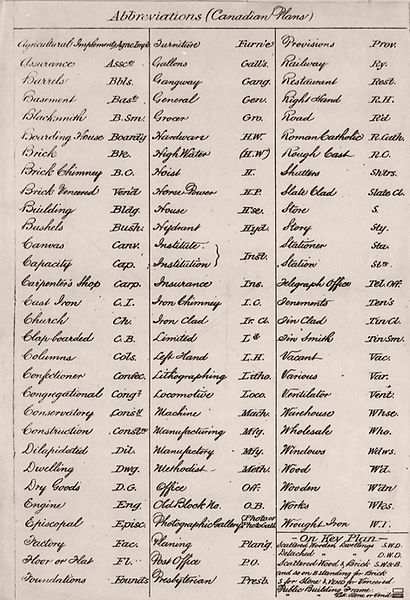
Block Plans

As a general rule, the original-format volumes depicted a place's built-up blocks at a scale of 50 feet per inch, while a 100-foot scale was used for outlying areas. The small-format volumes introduced in 1952 switched to a 100-foot per inch scale universally. In both formats, the applicable scale is noted on every sheet allowing original and current users to measure a structure's dimensions with remarkable accuracy.
Although the amount of symbols and annotations used in plans expanded significantly over the years, the shorthand used for basic residential features remained fairly consistent and is highlighted below as a quick reference guide.
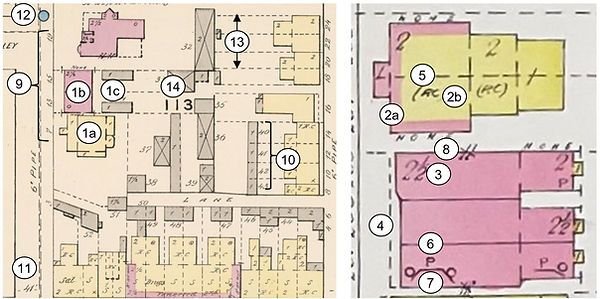
Common Building Content (Residential)
(1) construction material:
-
pink = brick
-
yellow = wood frame
-
grey = wood outbuildings (stables were specifically denoted by an X across the outline of the building)
-
orange (introduced in the early 1910s) = fireproof construction materials
(2) exterior cladding:
-
“RC” = roughcast (stucco)
-
pink outline along yellow building = brick veneer (block plans drawn at 100 foot per inch used pink buildings with a "V" label instead)
(3) number of storeys
(4) porch configuration (represented by dashed lines)
(5) interior partition wall (dashed line represents wood or plaster & lath)
(6) roof type:
-
circle = slate
-
P = tar & gravel or composition
(7) mansard roof
(8) side window indicator:
-
one slash = 1st storey, 2 slashes = 2nd storey etc.
-
“none” = no side windows
-
note: front and back of houses are assumed to have windows and so are not depicted
Block Infrastructure Content
(9) street numbers (written parallel to the buildings)
(10) building numbers (written perpendicular to the buildings):
arbitrary numbers used primarily to differentiate buildings on blocks where street numbers were often duplicated
(11) roadway widths (allowance for street, sidewalk and/or boulevard)
(12) fire hydrants
(13) lot lines (often only partial)
(14) block numbers:
arbitrary numbers assigned by the cartographers as a reference point for revision slips and for consistency across new editions[1].
Scaling Up

The large drawing scale employed by Goad made it relatively easy for original plan owners to physically measure building dimensions and spacing (with Goad's complementary scale ruler making it that much simpler). Today’s researchers have it even easier thanks to digitized versions which can be enlarged far beyond the original scale.
When zooming into a digitized image keep in mind that the fixed scale printed on the page no longer applies. For example, in the image above, the sheet originally drawn at 50 feet to 1 inch has been zoomed to twice its actual size so now the scale is 25 feet per inch as seen on the physical ruler held up to the screen. To determine a relative scale as accurately as possible, you'll likely need to obtain a high-resolution photograph of the sheet as most online reproductions are not sharp enough to clearly capture the scale (an iPhone's 48 megapixel HEIF setting works well for this purpose). You'll also need to make sure the camera is held directly above the sheet because photos taken at an angle will skew the perspective and throw off the sheet's scale across its length and breadth.
Revisions
Charles Goad recognized early on that his business’ success depended on his ability to keep plans both affordable and current. Surveying, drawing, etching, printing and hand colouring the pages of a new volume was a labour-intensive process. This meant that issuing entirely new editions of plans on a frequent basis to capture recent changes would increase his subscribers’ cost significantly, particularly for urban volumes that were comprised of dozens of sheets.
Instead, Goad chose a unique piecemeal approach wherein his staff would draw and print only the buildings that had changed since the previous update then paste these “revision slips” onto the pages of the original edition[2]. An annotation on the title page would typically indicate that only substantial changes merited a slip; minor alterations, changes to sheds, and commercial tenant occupation updates were left as-is unless included within a slip incorporating more major modifications.

The process for revising a plan would begin with Goad’s subscribers themselves as per his instructions in a circular affixed to an early 20th century Toronto volume:
When a new building is erected, or a change occurs affecting a risk, it should be pencilled on the plans as accurately as possible, and advice sent to [the insurance company's] Head Office or General Agent, who should see that their copies are also pencilled, so that in future reference to the same or adjoining property, the previously advised change will be seen at once. Neglect of this simple rule frequently gives rise to expressions of discontent with the careless method of procedure in the office corresponded with, be it H. O., General Agent, or Local Agent, and soon discourages those who, at first, strive to keep the plans closely corrected to date.
The numerous hand-drawn updates found in surviving copies of revised plans suggest this advice was followed by many subscribers.
Next, once enough insurance companies had asked for a plan to be revised or expanded, Goad’s staff would review the input they had received from agents in the field, resurvey the applicable area and prepare a collage of individual revisions on what were called transfer sheets. These revisions would be cut out and the slips placed in envelopes according to each plan. If a particular sheet required extensive changes, an entirely new sheet labelleled "reprint" would be issued to replace it.
Subscribers were then notified that a revision was available (for a fee) at which point they could return their copy to the Goad office where individual revision slips and entire reprints were pasted onto the pages, and the updated copies promptly returned to the customer.
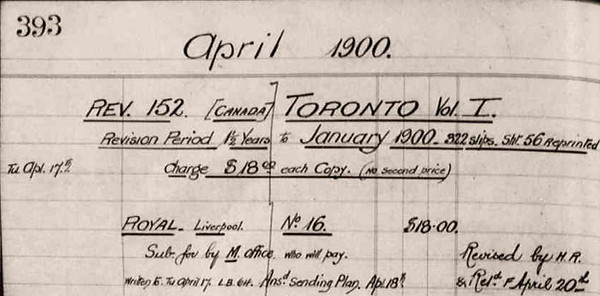
Goad ledger with revisions to subscriber plans. Header includes number of revision slips & reprint pages and cost of revision. Below are customer names and their unique copy numbers.
This process would be repeated multiple times for a given plan until the numerous revision layers interfered with the legibility of the pages. At that point, an entirely new edition would be issued and typically offered to existing subscribers at a discount if they ordered within a limited period. As with revisions, subscribers were required to first return their existing plan but this time it would be destroyed or used as paper stock for newer plans that would be printed on the reverse side.
With the introduction of the new plan format in 1952, the scrapbooking approach to revisions was largely eliminated. Modern printing technology, the ring-binder format and a focus on surveying only areas with significant changes since previous editions made it practical and affordable to replace individual pages as needed. The use of revision slips became limited to minor updates like changes to street names.
Familiarity with the specifics of the revision process can provide today's researchers with the ability to confirm publication dates claimed by collection holders and narrow down time ranges for individual changes in volumes that were revised many times over their lifespan[3].
Plan & Sheet Date Slips
While collection holders and the Catalogue of Canadian Fire Insurance Plans are generally very accurate in their dating of insurance plans, they occasionally make mistakes so it never hurts to verify.
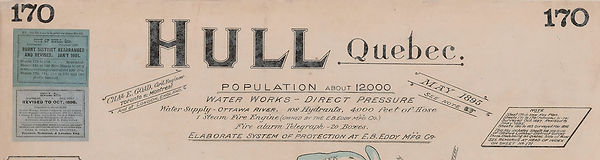

The most reliable method for confirming the year that a copy was revised is to check the date on its introductory page. During the Goad era (up to 1917), original edition dates and subsequent revision dates would be noted in the form of a “blue slip” pasted on this page. Each time an edition was updated, a new blue slip would be pasted over the former. During the Underwriters’ Survey Bureau era, the process continued but the date revision slips were printed on "buff" coloured paper. For larger plans, the slips would sometimes also indicate which sheets were entirely reprinted or which new sheets had been added.
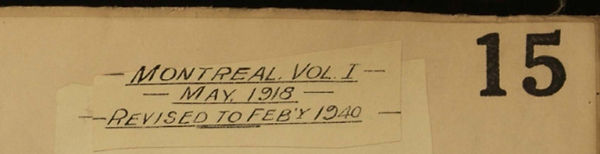
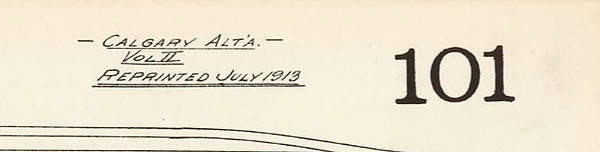
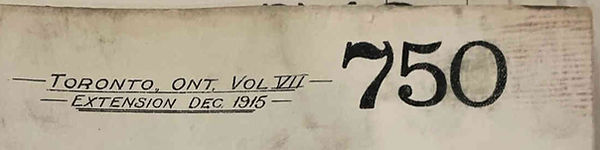
If the title page is missing from a copy, the next best approach is to check the dates at the top right corner of each block plan sheet. The date of the revision will typically be pasted over the original date and if the page is a reprint or "extension" (a new sheet added to a plan with previously unsurveyed blocks) this date will also be noted.
There are a couple of important caveats to keep in mind when referring to these plan and sheet dates:
-
In rare cases, revised sheets will not have their dates revised. If the sheet dates (or plan date) seem to predate some of the survey details, check the revision slips in the body of the page to see if they bear a revision date. If not, see if they contain a building that doesn't appear in a previous edition and, if so, determine that building's construction date using other resources. You can then deduce that the plan was revised sometime after that construction date.
-
When checking sheet dates, check every sheet in the plan. Updated plans are typically a mix of revised and unrevised pages so if you review only a few sheets they may all be unrevised or earlier revisions and so give the impression that the plan's update took place sooner than it actually did.
Revision Slips
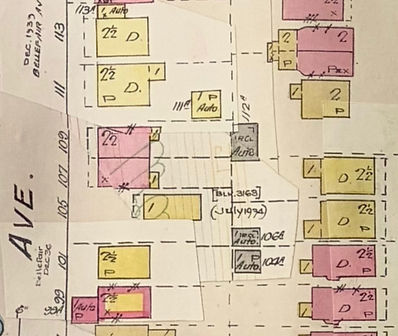
Prior to 1930, plans that were revised multiple times over the years provided no method to determine when a specific revision slip was added. After that year, revision dates were noted on individual slips making it much easier to identify when a change took place providing a slip wasn't subsequently covered by another. Typically these dates are noted near the street name or block number on each slip as seen in the example above.


When no copies of a revised edition survive, it can be possible to extrapolate that the changes in the revised version with original revision slip compilations called "transfer sheets" that are available in some plan collections.
For example, the copies of the May 1951 revision of a Toronto volume held by two different repositories do not show the major downtown extension of a street called Mount Pleasant Road that was completed earlier that year (seen above at left). And while a copy available at a third repository (at right) includes the update, much of it is covered by hand-drawn revisions from 1953. Consequently, none of the three available copies depict how this significant development first transformed the neighbourhood. However, the Toronto Reference Library holds the actual April 1951 transfer sheets for this volume, allowing researchers to deduce this missing information[4]. This is seen in the middle image where the revision slip has been digitally superimposed onto the original page.

Sample revision slip transfer sheet.
The anatomy of a transfer sheet is fairly straightforward: each cluster of revision slips is labelled with the corresponding plan name, the plan’s sheet number (in large bold numerals) and the total number of slips created for that sheet. Note that slips for a single plan page were sometimes spread across multiple transfer sheets while, conversely, revisions for multiple plans were sometimes printed on a single transfer sheet.
Instructions on how to locate holdings of surviving revision slips can be found in the COLLECTIONS section of this Guide.
Hidden Treasures


The comparative value of digitized plans is obvious in that they offer instant access. The value of physical originals requiring in-person viewing may not be as apparent at first but is nonetheless substantial.
For starters, even high-resolution scans are often less legible than hardcopy originals. Take the example above where the resolution of a black and white online version blurs annotations that are perfectly legible in the colour original.
Secondly, hardcopies of revised editions allow researchers to become forensic detectives and literally see through layers of time. Using the same sample reproduction, the detail of the original sheet is barely visible underneath the revision slip. However, a bright light placed behind the physical version of that page brings the underlying original to life: we can see not only the shape of disappeared buildings but also their addresses and structural details. This historical background is particularly valuable when no copies of a plan's unrevised edition exist.
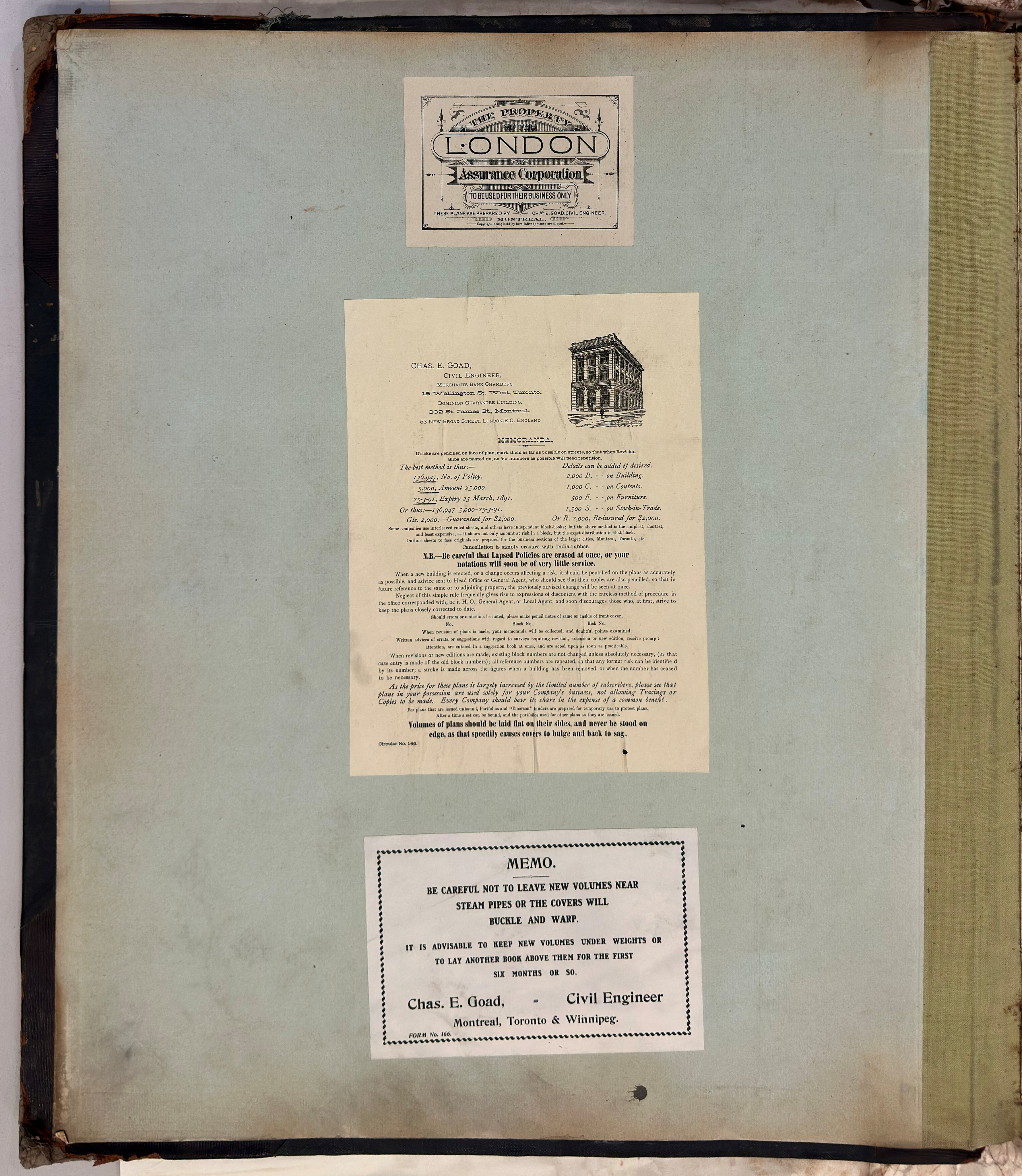
Use and care instructions and an owner ID sticker inside the cover of a 1907 bound plan.

Ledger found in a 1951 Toronto plan volume listing insured properties by block number.
In a similar vein, because edition copies were revised individually rather than en masse, it can be beneficial to inspect more than just one. This was the case for a Toronto volume originally issued in 1897 then completely reprinted in 1913 and 1916. After finding that a black and white reproduction was the only copy of the 1916 revision available online, I turned to hardcopies held by other repositories. While the first copy was basically identical to the digitized version, the second turned out to be a fascinating anomaly: more than a third of the pre-1913 sheets had only been updated with revision slips rather than entirely reprinted. This was significant because reprinted sheets lack the historical artefacts that are layered onto revised sheets. Consequently, I was able to discern details from not just some 1897 originals but also from two rounds of extension sheets added prior to the reprint.
Lastly, comparing multiple copies can also offer up results that are completely unrelated to the research at hand: the first hardcopy of the aforementioned 1913/1916 volume I viewed turned out to have two sheets from a Montreal plan printed on the back of a couple of pages, one of which was a very rare transfer sheet. Other volumes have offered up insights into the copy's original owner in the form of information labels affixed to the front covers or loose leaf business records forgotten between the pages of a donated volume.
Notes
CONTENT
[1] For Toronto volumes 1-9, block numbers are random numbers between 2 and 4 digits. Beginning in the 1930s, a more formulaic numbering system was implemented for brand new volumes i.e. volumes 10 and up. This is noted in the universal abbreviation index for all new plans after 1950.
REVISIONS
[2] Goad used the terms “revision slips” and “correction slips” interchangeably. I have opted for the former for the sake of consistency.
[3] The 1912 edition of Toronto volume 7, for example, was revised 14 times over a span of nearly 40 years.
[4] In this particular case, the transfer sheets reveals that the road extension update also applied to volumes 5 and 7, despite the fact that the Catalogue of Canadian Fire Insurance Plans doesn’t note any revisions to volume 7 around this time.
Illustration Credits
FORMAT
-
original plan format: Peter Marshall
-
ring binder plan format example: Peter Marshall
CONTENT
-
1906 Winnipeg key plan: Library and Archives Canada
-
key plan reserved sheet number examples:
-
Toronto plan volume 8, 1916: Library and Archives Canada
-
Toronto plan volume 9, 1956: Peter Marshall
-
Toronto plan volume 6, 1965: Peter Marshall
-
-
index examples:
-
1907 Orangeville key plan and index: Library and Archives Canada
-
Vancouver plan index, 1897: Library and Archives Canada
-
-
symbol key examples:
-
Toronto plan volume 1, 1880: Toronto Archives via "Goad's Atlas of the City of Toronto"
-
Toronto plan volume 9, 1965: Peter Marshall
-
-
abbreviations legend: Charles E. Goad Company fonds, Library and Archives Canada microfilm reel H-1815, image 182 at Canadiana.ca
-
block plan of Regina, 1907 revised to 1913: Library and Archives Canada
REVISIONS
-
Toronto plan volume 1A 1921 revised to 1943: Peter Marshall
-
Charles Goad ledger: Charles E. Goad Company fonds, Library and Archives Canada microfilm reel H-1815, image 257at Canadiana.ca
-
plan date slip examples:
-
Hull plan: Library and Archives Canada
-
Montreal plan volume 1, 1918 revised to 1940: Bibliothèque et Archives nationales du Québec
-
-
sheet date revision slip examples:
-
Montreal plan volume 1, 1918 revised to 1940: Bibliothèque et Archives nationales du Québec
-
Calgary plan volume 2, 1911 revised to 1913: Library and Archives Canada
-
Toronto plan volume 7, 1912 revised to 1915: Library and Archives Canada
-
-
revision slips with dates (from Toronto plan volume 9, 1939 sheet 923): Peter Marshall
-
revision slip transfer sheet: Peter Marshall
HIDDEN TREASURES SIDEBAR
-
use and care instructions from Toronto Reference Library copy of Toronto plan volume 5, 1907 revised to 1914: Peter Marshall
-
Norwich Union ledger: Peter Marshall